As a child of hippie parents, I know all too well the stories of how the extremely creative, musical, and peace-loving young people of the 1960s went West in search of a better life. The Gold Rush of the mid-1800s was very different in that the people heading West then were doing so to claim the land and find riches in mining gold.
During that time, people who wanted to lay claim to land in Oregon traveled the notable Oregon Trail. According to historians, the Oregon Trail and its many offshoots were used by approximately 400,000 settlers, farmers, miners (for gold), ranchers, and business owners, along with their families, to travel to the area known as Oregon and its surroundings. Traffic on the trail was especially thick from 1846 to 1869.
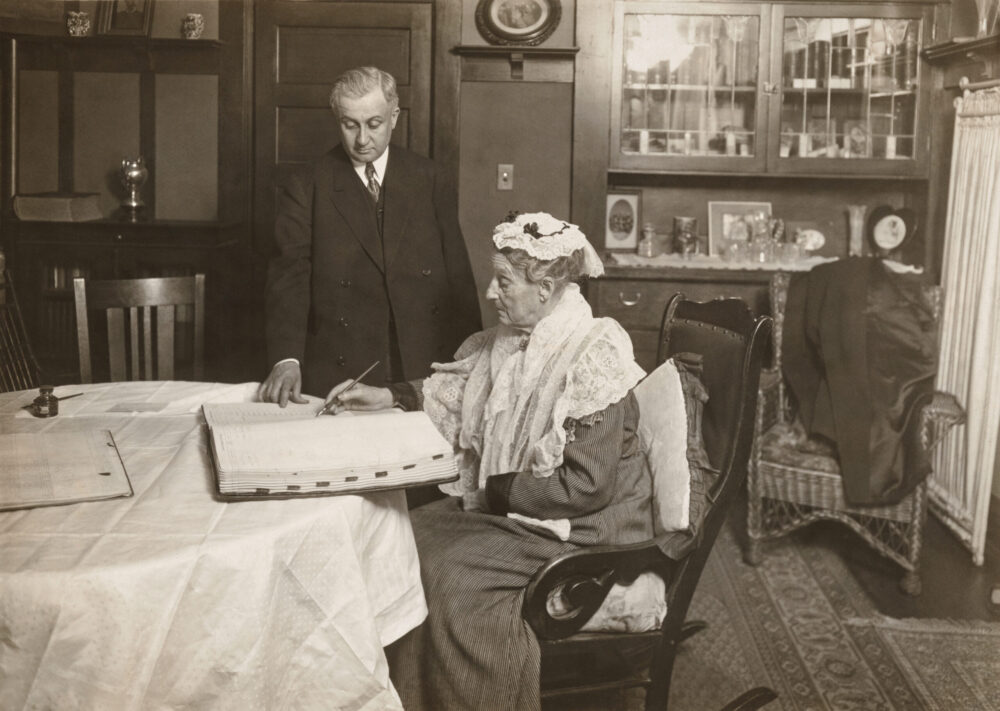
However, one very significant person from Oregon in the late 1800s was Abigail Jane Scott Duniway, an American women’s rights advocate, newspaper editor, and writer. She was instrumental in gaining voting rights for women in the United States.
Wikipedia writes about this famous woman from Oregon, stating that, “Before addressing the Oregon legislature, Abigail Scott Duniway toured the Pacific Northwest in the company of the famous Susan B. Anthony, one of the leading voices in the Women’s Suffrage movement. In 1872 she was invited to address Oregon’s legislature to put forward the case for women’s suffrage. She was appearing on behalf of the Oregon State Woman Suffrage Association, but no one wanted to keep her company.
Her persistence paid off in 1912 when Oregon became the seventh state in the U.S. to pass a women’s suffrage amendment. Governor Oswald West asked her to write and sign the equal suffrage proclamation. She was the first woman to register to vote in Multnomah County,”.
Hmm, I feel like I should have learned about her in grade school, if not, then in college U.S. history for sure. What a shame that Abigail’s name is not more well-known.
The flower children who marched for peace, women’s liberation, and civil rights in the 1960s had a quite different purpose than the greedy gold rush miners. Most of the free-spirited young people traveled West from across the country, coming from places like Michigan or New York, to meet like-minded individuals at the famous Haight-Ashbury community in central San Francisco, California.
One of the most famous people who came from Oregon during the 1960s was Ken Kesey. Oregon Public Radio reports, “Ken Kesey (1935–2001) is one of the best-known authors to ever emerge from Oregon. He wrote his two most-acclaimed novels, One Flew Over the Cuckoo’s Nest (1962) and Sometimes a Great Notion (1964), when still in his twenties.
Then in 1964, he and his friends, the ‘Merry Pranksters,’ made what would become a legendary cross-country bus trip. They returned to produce a series of boldly-different social events, the Acid Tests. Tom Wolfe’s Electric Kool-Aid Acid Test recounted all of this, and propelled Kesey and the Pranksters to celebrity status.
The 1960s became a time of ‘sex, drugs and rock ‘n’ roll,’ and the news media gave Kesey much of the credit. They anointed him “a founding father of the ’60s counterculture,” though Kesey would claim to have only ridden the wave that brought the changes.
By the year 1967 and the “Summer of Love,” Kesey and his family had already moved back to a small farm in Oregon. Ken Kesey would forge through his remaining 30-some years as a writer, actor, farmer, family man and all-around character. He kept his Prankster friends and his zany ways,”.
While musicians like Bob Dillon, The Beatles, Janis Joplin, The Grateful Dead, Jefferson Airplane, and Big Brother and the Holding Company were singing about civil rights and against the Vietnam War, we also had our pioneers in music here in Michigan.
(Photo Credit: By The Oregonian, restored by Adam Cuerden – Oregon Historical Society, Oregonian glass negatives; Org. Lot 139; Negative 4603, Public Domain)
What is the famous music movement that started in Detroit in the late 1960s?
The famous music movement that started in Detroit in the late 1960s was the musical magic of Motown. As mentioned, my mom was a hippie, but not just any hippie; she was a White Panther (a radical, anti-racist socialist group) and spoke loudly against the injustices of the time, and was strongly against the Vietnam War, like many Motown artists were as well.
She lost many friends and cousins to the Vietnam War, she was hit with batons from police as she peacefully protested for civil rights, and she proudly burned her bras during the women’s liberation movement.
She was a hero and firmly stood on the right side of history, just as her father had when he fought against fascism in World War II. I am proud to have ancestors who displayed such courage and compassion!
My mom was very into the music of the tumultuous 1960s. She shared freely stories about seeing Detroit artists, such as the MC5, Marvin Gaye, and people like Edwin Starr in concert, and read John Sinclair’s poetry. She introduced me to folk music, rock and roll, and our hometown favorite: the music of Motown.
Of course, as a lifelong Michigander, I love the sounds of Motown!
Motown and the Civil Rights Movement
Although the songs were not overtly political, Motown’s popularity contributed to the Civil Rights movement by achieving crossover success, placing African American songs and faces in the homes of people across the country, regardless of their race.
According to Boston College University Libraries, “Gordy received a call from the Beatle’s manager, Brian Epstein. Epstein raved about the “Motown Sound” and went on to describe how much the Beatles loved Motown, the songs and the artists. The Beatles gave an ecstatic public endorsement of Motown while Motown was on their UK tour in 1965 and John Lennon publicly claimed that Marvin Gaye’s “Can I Get a Witness?” was one of his favorite songs. After boosting Gordy’s ego quite a bit, Epstein pitched the idea of the Beatles recording three Motown songs, the Marvellettes’ “Please Mr. Postman,” the Miracles’ “You’ve Really Got a Hold on Me,” and one of the first Motown hits, Barrett Strong’s “Money (That’s What I Want),”.
“You Really Got a Hold on Me” is my all-time favorite Motown hit, whether Smokey Robinson or The Beatles sing it. However, I do love “What’s Going On” by Marvin Gaye – it still gives me goosebumps and I get emotional every time I hear it. It remains highly relevant for our times.
BET (Black Entertainment Television) cites Civil Rights Era Protest songs with, “Marvin Gaye – What’s Going On album (1971) – Marvin Gaye’s 1971 classic What’s Going On is a concept album that narrates the story of a Vietnam vet as he arrives back home from war. The title track became a crossover hit and one of the most memorable anti-war songs of the era. “Inner City Blues (Make Me Wanna Holler),” also on the album, touched on the poor economic situation that plagued America’s ghettos, while “Mercy Mercy Me (The Ecology)” talked about the poor state of the environment in the years that followed the civil rights movement,”.
Famous celebrities from Oregon
In conclusion, from suffragists to counterculture icons, Oregon’s legacy proves that bold voices and creative spirits can shape history across generations.