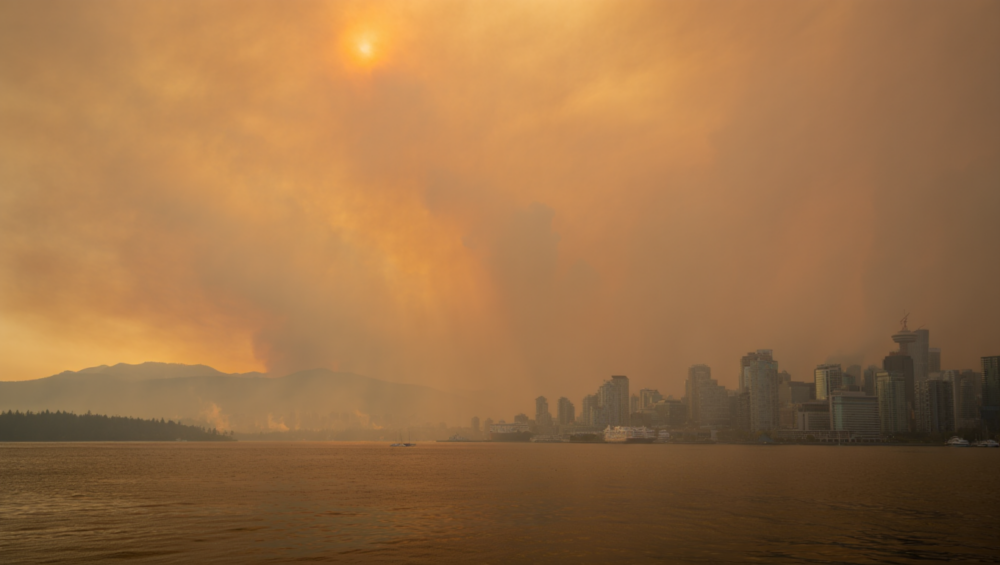
Do fires claim Vancouver as their victim? Well, for starters, Vancouver, British Columbia, is most commonly known as “Raincouver” or “Rain City” because of its high rainfall. The city, which ranks as the ninth rainiest city in Canada, receives an average of 182 mm of precipitation during its wettest months of November to December.
However, as the summers get hotter and drier because of climate change, that sense of security is shifting. While you won’t see a massive wall of fire sweeping across the city, Vancouver faces a unique and intensifying set of risks, from “hidden” fuel in its major parks to the smoke that now clouds Rain City’s skies every summer.
Situated in Canada’s coastal western hemlock zone (CWH zone), Vancouver features one of the country’s wettest climates and most productive forest areas. This biogeoclimatic zone is typically characterized by mist, drizzle, cloud cover, moist Pacific winds, and thick underbrush in the forest canopy in its steep coastal mountains. Because of this, the city felt naturally shielded from the devastating wildfires that regularly haunt the British Columbia interior or the Okanagan Valley.
The Myth of the ‘Fireproof’ Forest
Vancouver sits in a coastal western hemlock zone, an ecosystem historically defined by high humidity and heavy rain. In the past, fires were rare because the ground was simply too wet to burn.
Instead, the forest “recycles” itself when windstorms knock down old trees in a natural process called gap dynamics. Also known as gap-phase regeneration, this is the primary way Vancouver’s temperate rainforests renew themselves in the absence of large wildfires.
However, the city is now seeing a “rainfall deficit,” which is just a fancy way of saying it isn’t getting enough rain to keep the forest floor damp through the summer. Record-breaking events, such as the 2021 Western Heat Dome, act like a giant hairdryer which sucks the moisture out of logs, moss, and soil.
What’s more, scientists warn that by 2100, Canada’s fire season may lengthen by more than a month in certain forest regions, including northern British Columbia.
Wildfire-Prone Areas in Vancouver BC
Some areas in Vancouver are more at risk of wildfires than others. The top 2 are Stanley Park and the Pacific Spirit Regional Park area. There is also the innate vulnerability to fires of areas where urban dwellings and the forest meet.
- The Crisis in Stanley Park Forest
The most immediate direct fire threat to the city is currently Stanley Park. If you’ve walked the trails lately, you may have noticed brown, dying hemlocks. This is the work of the Western Hemlock Looper moth, a tiny insect that has caused a massive mortality in the park.
As of 2023, about 30% of the Stanley Park’s larger trees have been killed or severely damaged by these moths.These dead trees, known as “snags,” are essentially standing kindling. They create ladder fuels that allow a small ground fire to climb into the treetops, which turns a manageable fire into a dangerous crown fire.
Today, roughly 24% of Stanley Park is officially classified as a “high” or “extreme” wildfire risk, especially around Prospect Point and the northern trails where human activity is highest.
- Pacific Spirit and the Beach Risk
Pacific Spirit Regional Park (PSRP) is another area of concern. Surrounding the University of British Columbia (UBC) campus, it features steep, sandy cliffs that are perfect for convection, a process where heat rises and pre-dries the fuel above it, making fire spread uphill incredibly fast.
In June 2021, a roughly 150-square-meter fire broke out on the difficult terrain near Wreck Beach. Historically, fires in this park are almost always caused by human activity, i.e., illegal campfires, discarded cigarettes, or sparks from nearby encampments.
Because the park is so dense and the narrow trails limit vehicle access, it can take fire crews a long time to reach the “seat” of a fire deep in the woods.
- The Threat of the Wildland-Urban Interface
Most people think of a wildfire as something that happens far away in the woods. However, Vancouver’s biggest danger is the Wildland-Urban Interface (WUI). This is the zone where houses and buildings meet the forest edge.
Note that during a wildfire, embers can travel as far as 2 km, on average, before falling and possibly starting a brand-new fire elsewhere. Some embers have even been documented to reach 17 km. This means that if a fire starts in a place like Pacific Spirit Regional Park, the wind could carry glowing embers (firebrands) 2 kilometers away, landing on roofs or in gutters in West Point Grey or Dunbar-Southlands, for instance.
A terrifying example of this occurred in August 2024 during the West 41st Avenue fire. While this started in a wood-frame building under construction, the heat and wind cast embers into the surrounding neighborhood and sparked multiple small fires on nearby homes. This “ember storm” is exactly how wildfires destroy cities, even if the main forest fire never touches the houses directly.
The Invisible Threat of Wildfire Smoke
Even if a single tree never burns within city limits, Vancouver is now undeniably at risk to wildfire smoke. In fact, the city now ranks wildfire smoke among its top major hazards of concern, alongside earthquakes and flooding.
Wildfire smoke is a toxic soup of gases and PM2.5, which are tiny particles 2.5 micrometers or less. These are small enough to enter your lungs, travel directly into your bloodstream, and cause inflammation. For people with asthma, heart disease, or for seniors and young children, this isn’t just a nuisance; it’s a medical emergency.
To combat this, the city has designated “cleaner air spaces.” Locations like the Carnegie Community Centre, Hillcrest Community Centre, and the VPL Central Library are equipped with high-level air filtration systems to give people a break from the haze.
A New Reality for Rain City
Vancouver isn’t the Okanagan, i.e., the city’s forests are still mostly too wet to support the massive, unstoppable “mega-fires” seen in the interior. But, it is in a period of transition.
Its rainforest status is no longer a shield, rather it’s a responsibility. With Stanley Park struggling with tree mortality and summers becoming increasingly brittle, the risk of a fast-moving fire in Vancouver’s urban parks is real.