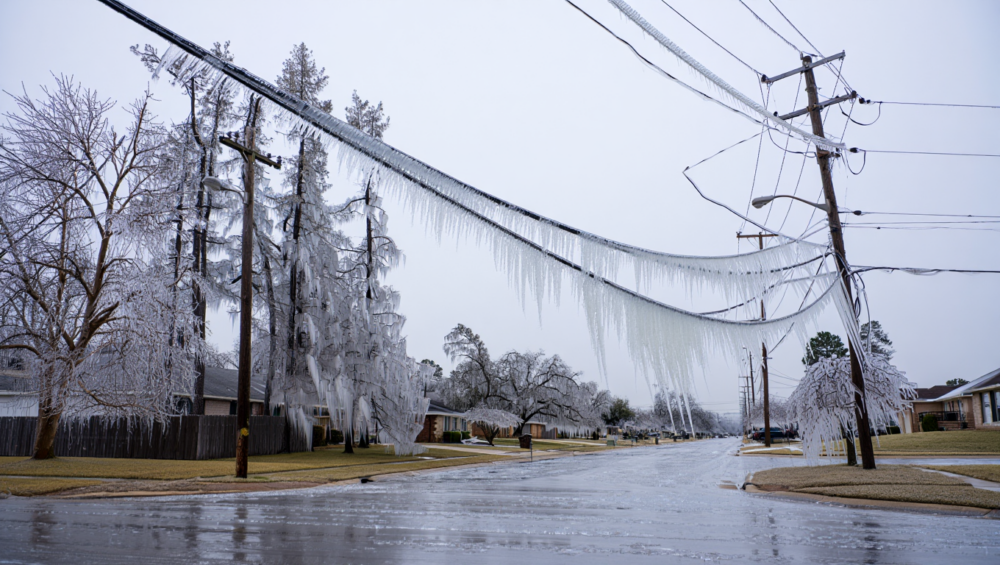
When it comes to natural disasters in Houston, it’s common to hear about extreme heat, wildfires, hurricanes, tornadoes, and flooding. But, every few years, the Texan city of Houston also deals with ice storms.
While major events are rare in the city and the rest of Southeast Texas, when ice storms hit the region, they do so with a cold and dangerous vengeance. Unlike light and puffy snow, ice is heavy and slippery, and it is capable of bringing a massive metropolis like Space City to a complete halt.
How an Ice Storm Forms
In a normal winter, the air from the clouds to the ground is cold all throughout. For an ice storm to form, imagine the atmosphere like a giant sandwich, where warm, wet air is stuck between the cold air in the upper atmosphere and a thin layer of freezing, heavy air that stays trapped near the ground.
The snowflakes that the clouds produce melt completely when it hits the warm air, resulting in freezing rain. However, when these liquid water drops fall through the thin layer of cold air near the ground, it isn’t enough to freeze them. (If this cold air layer was deep enough, it would result in sleet.) Rather, water becomes supercooled, or it has cooled to below the freezing point (32°F or 0°C) but remains in a liquid state, i.e., it did not turn into solid ice.
Because the water droplets are already cool, they instantly freeze when they hit the freezing or below freezing ground. That’s the thin layer of ice that you see on exposed surfaces, such as pavements, roads, or tree branches.
An accumulation of freezing rain lasting for several hours or more results in an ice storm. According to NOAA’s National Severe Storms Laboratory, for an event to be considered an ice storm, there must be at least 0.25 inch of ice on exposed surfaces.
Freezing rain mostly occurs east of the Rocky Mountains, according to the National Weather Service (NWS). This area covers a broad region, from Texas northward to Minnesota and eastward into the Middle Atlantic states and New England.
Why Ice Storms are a Problem
Imagine getting outside and seeing the pavements and roads covered in a glaze of ice. That would be really dangerous to walk in or drive. If you do, you might be facing personal injury or automobile accidents. Even light accumulations can make walking and traveling dangerous.
In addition, an accumulation of ice is heavy. Unlike powdery snow that sits on branches and other surfaces, ice can weigh them down. Ice storms have been known to break tree branches and snap powerlines. The latter often causes localized power outages.
In Houston, these issues are exacerbated by the fact that the city doesn’t have the equipment nor experience to handle icy or frozen conditions. According to meteorologists, ice can have the following consequences:
- Trace to 0.25 inches: Roads become very slippery, especially on overpasses and bridges. You might see a few power outages too.
- 0.25 to 0.75 inches: This is where things get serious. Travel may become impossible, e.g., air travel might be disrupted, and tree limbs can snap under the weight of the ice, leading to power outages when powerlines are damaged.
- Over 0.75 inches: This is considered a “catastrophic” event. Widespread power outages and massive tree damage are almost certain.
To put this in perspective, just half an inch of ice can add as much as 500 pounds of extra weight to power lines and tree branches.
“Ice accumulation definitely poses the largest threat to our electrical infrastructure… even a thin glaze of ice can cause those tree limbs to sag or break or fall into our powerlines,” a representative of Oncor, a Texas electric delivery company, told CBS News.
Houston Isn’t ‘Built’ for Ice
While Space City faces many types of extreme weather regularly, ice storms isn’t one of them. This Chron article explains:
“If you moved to Houston from the North, you might wonder why the city struggles with just a little bit of ice. The reason is simple: it doesn’t happen often enough to justify spending millions on specialized equipment.”
For instance, when it comes to keeping the roads and pavements free of ice, the city has just around 15 sand spreaders and about half a dozen brine applicator units (machines used for spraying salt water or brine), and it owns no snowplows. However, that may not be enough for the over 16,000 lane miles of roadway that Houston is responsible for. That distance is like taking a round-trip from Houston to Tokyo!
Furthermore, it’s typical for Houston to experience rain just before a drop in temperature. So, any salt or brine that might have been put down to prevent ice just washes away.
Some areas like Harris County Precinct 4 use chat rock, a type of fine or ground-up gravel primarily used in landscaping. The county says the material is a non-chemical alternative to salt or brine that is effective in increasing traction and reducing slip hazards, especially on overpasses and elevated roadways.
Examples of Ice Storms That Hit Houston
Houston has faced several major winter events. When it comes to ice storms, here are two of the most notable:
The Ice Storm of 1997
In January 1997, a classic ice storm hit the region. Up to 1 inch of ice piled up on trees and power lines.
“Ice remained a fixture across the region until the afternoon of the 14th when temperatures finally rose well above freezing,” the NWS noted.
The results were devastating: About 75% of the area between Beaumont, TX and Lake Charles, LA lost power, including Houston and Galveston. Some people were stuck in the dark for as many as five days.
As the ice began to melt, chards of ice fell from tall buildings and towers, making it dangerous even to walk outside.
“More tree limbs fell and additional power outages were reported. This made movement across the region dangerous and potentially life threatening near the larger structures,” the NWS further stated. “Crashes were heard outside the weather office as sheets of ice fell off the Doppler radar!”
The Valentine’s Week Winter Outbreak of 2021
An ice storm that’s still fresh on Houstonians’ memories occurred in February 2021. This winter outbreak not only brought freezing rain but also snow, sleet, and several days of extreme cold temperatures to Southeast Texas. Houston’s temperature dropped as low as 13∘F (-10∘C).
“This was one of the most impactful winter events in recent history that brought multiday road closures, power outages, loss of heat, broken pipes, and other societal impacts for the region,” the NWS reports.