When I heard about a lake tsunami in BC, I was shocked and maybe a little concerned. If a large inland lake can succumb to the effects of a tsunami, then living in Michigan, with the Great Lakes surrounding us, could pose a serious threat.
Naturally, I assume floods in British Columbia were a result of the inland lake tsunami that occurred because when waves measuring at least ten feet high crash onto land, you might imagine that a lot of water is being dispersed on contact. Let’s see what the experts have to say.
The CBC (Canadian Broadcasting Channel) reports that the last tsunami in British Columbia was in 2007. CBC notes the following, “You’ve heard of a tsunami, a series of waves caused in a body of water by the displacement of that water. Warnings about tsunamis are often issued for communities near the ocean following powerful earthquakes.
But have you heard of a lake tsunami?
In December 2007, a massive landslide crashed into Chehalis Lake, a smaller body of water situated between Harrison Lake and Stave Lake in southwestern B.C., triggering a tsunami that surged 38 metres up the shore.
As CBC’s Johanna Wagstaffe explains, heavy rain falling on snow on an already fractured bedrock caused the rock to go tumbling down from Mount Orrock. The slide sent a wave up the opposite shore and down the entire length of the lake,”.
By definition, according to Michigan State University, a lake tsunami is, “Tsunamis in the Great Lakes are technically called meteotsunamis, or tsunamis caused by meteorological conditions. A meteotsunami is defined as a rapidly moving wave that can be generated by quickly changing air pressure or high wind speeds or a combination of both. While these meteotsunami waves are not nearly as big as those generated by seismic tsunamis, NOAA reports a wave was actually measured off Chicago in 1954 at 10 feet high, and when it hit, several people were knocked off a pier and seven drowned.
Have there been any notable meteotsunamis in the Great Lakes in recent years? Yes, according to the new research, in 2014 a Lake Superior meteotsunami overtopped the Soo Locks, impacted shipping operations and caused evacuation of some homes in Sault Ste. Marie, Ontario. And the NOAA report documented another one in 2012 off Cleveland, Ohio, knocking people on the beach off their feet and swamping boats in harbors,”.
How high does a wave have to be to be considered a tsunami?
The NOAA (National Oceanic and Atmospheric Association) shares the following regarding what height a wave must be to be considered a tsunami, “A tsunami’s long wavelength provides more momentum for inundation (flooding), so tsunamis often travel much farther inland than normal waves and are more destructive. A large tsunami can flood low-lying coastal areas more than a mile inland.
The maximum height above sea level a tsunami reaches on shore is called the runup. Most runups are less than 10 feet high, but in extreme cases, can exceed 100 feet when a tsunami strikes near its source.
The first wave to reach the shore may not be the last, the largest, or the most damaging. Large tsunamis may continue for days in some locations, reaching their peak often a couple of hours after arrival and gradually tapering off after that,”.
As a lifelong Michigander, I have camped all over this beautiful peninsula and swam in all five Great Lakes, including:
- Lake Superior
- Lake Michigan
- Lake Huron
- Lake Erie
- Lake Ontario
Lake Ontario is the only Great Lake that does not touch the shoreline of Michigan, but I swam in that lake when we visited Niagara Falls, Ontario, Canada, and when we were in Upstate New York.
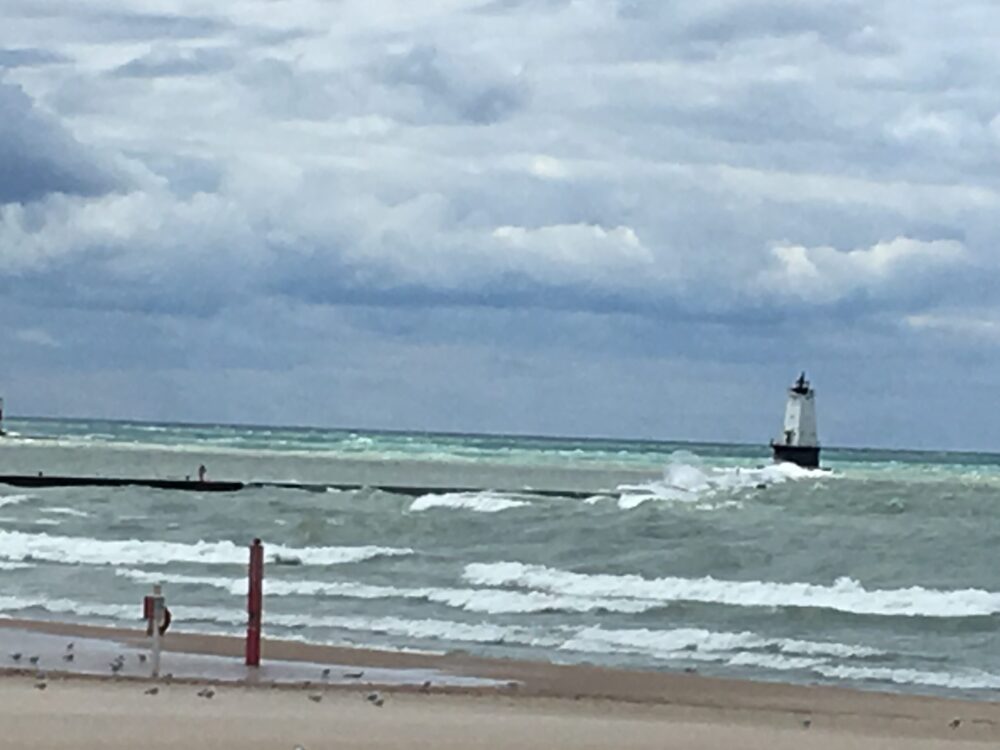
The largest waves I ever saw on a Great Lake were on Lake Michigan in late August when my sons and I were camping in Ludington State Park a few summers ago. There was a red flag warning for rip currents; however, we swam anyway (I do not recommend or advise anyone to do so).
The rare occurrence is featured in the photo above, showing waves crashing over the pier and reaching heights halfway up the lighthouse.
Thankfully, we had our boogie boards and are strong swimmers. We had so much fun that day as the waves were measuring around eight feet high! I wonder if there was a possibility of a tsunami.
In fact, the waves were so big that I have never seen waves that large in the Atlantic Ocean or the Gulf of Mexico. Of course, the waves I swam in off the coast of Zihuantanejo, Mexico, in the Pacific Ocean, were much larger.
Still seeing waves eight feet high in Lake Michigan is unusual and hard to resist, especially since the Great Lakes are salt-free and shark-free!
Worst tsunamis in BC
Besides the lake tsunami, there were a few significant tsunamis that severely affected BC in the past. Some Canadian experts wrote that, “There have been three in recent years, one in 1946 , 1975 as well as one in 1964.
The June 23rd, 1946 tsunami in Vancouver island, on the coast of British Columbia had started out as an earthquake, a magnitude of approximately 7.3. The shaking had been felt all across from Portland, Oregon to Prince Rupert, British Columbia.
It had then caused an underwater landslide creating a tsunami , also triggering a rock avalanche on a lake creating a large wave that caused severe damage to a nearby forest. The height of the waves then were around 29 m – 51 m. Thankfully, only one person had drowned.
The 1975 British Columbia tsunami was triggered by a submarine landslide in Moon Bay, Kitimat Arm. Although there was much damage done to buildings, there were no injuries or deaths. Wave heights were up to 8.2 meters.
Lastly the 1964 tsunami disaster on the BC outer coast (Alaska). Created by a magnitude 9.2 earthquake in Alaska that struck Vancouver Island with waves over 6 m. This created massive destruction to homes, cars, and buildings. However, no lives were lost,”.
When was the last tsunami in BC
In conclusion, understanding B.C.’s tsunami history—and our own meteotsunami risks—reminds us that inland waters can be powerful too. Awareness, not alarm, helps us appreciate these forces while staying informed and prepared.