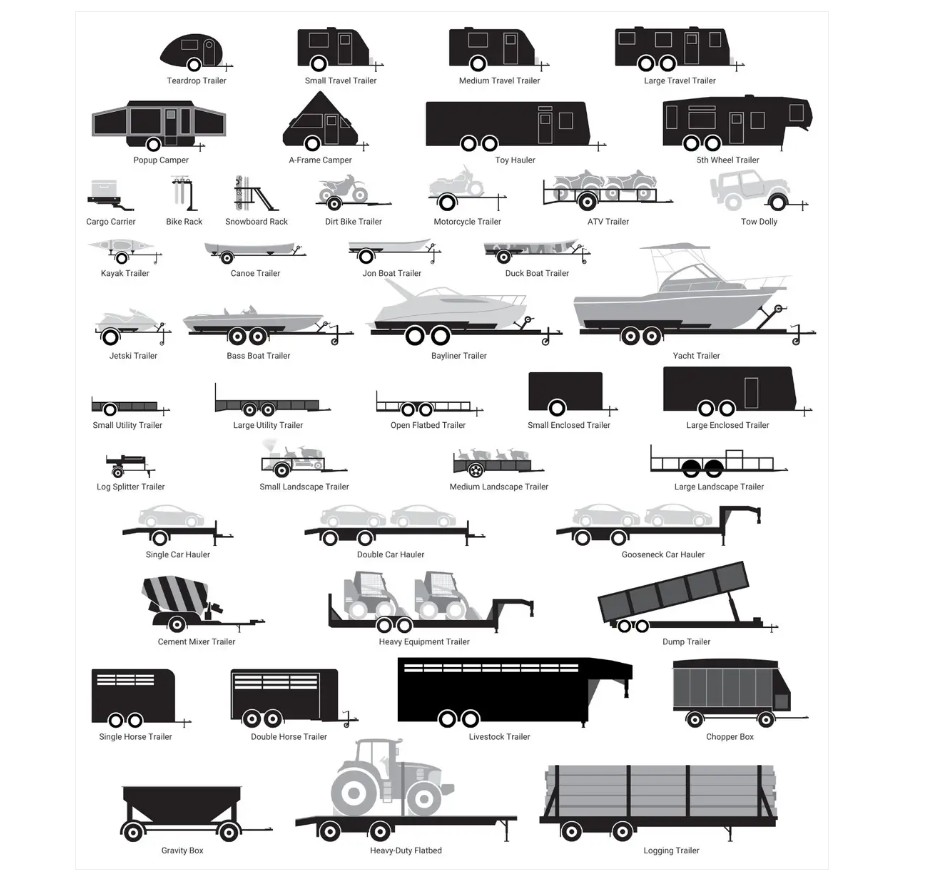
Recently, I went on a camping trip and saw the neighboring camper a few campsites away with an enclosed trailer converted into a camper. It reminded me of the type of landscaping trailers (both open and enclosed) my ex-husband, a landscape contractor, has had and currently has use of for hauling equipment.
Of course, these are used during the months in Michigan when the ground isn’t frozen, or there isn’t snow on the ground. Otherwise, he is driving around in a pickup truck with a snow plow attached for snow management services – which, by the way, I do not even want to think about snow just yet since it is still summer!
In addition to being married and in a relationship with a landscaper for almost thirty years, I grew up in a family that owned a general contracting company (my mom and her brother, my uncle). They had big stake trucks and dump trailers for complete roof tear-offs and remodeling projects.
When my ex-husband (boyfriend at the time) had his open landscape trailer, we used it to haul our ATVs (quad dirt bikes), with our camping gear packed around them. We had our tent, awning tent, tools, coolers, clothing bags, and several bins full of supplies and food.
Different types of trailers that immediately come to mind include the following, but are not limited to:
- Landscaping trailers (open and enclosed)
- Dump trailers
- Car haulers
- Semi-trailers
- Travel trailers/pop-up campers/campers/RVs
- Boat trailers
- Moving trailers
- Hauling trailers
- Enclosed trailers for commercial use (musicians, events, etc.)
- Flatbed trailers
- Hitch cargo trailers/small utility trailer
Recently, I had to get a hitch system installed on my crossover vehicle so I could tow a pop-up camper safely. The hitch system installer was wonderful and recommended a certain brand for the wiring device needed to activate the trailer brakes. More specifically, it functions as a wireless trailer brake controller that plugs into a standard 7-way socket and lets you safely operate and monitor electric trailer brakes using a smartphone.
According to the trailer experts at CURT, “Trailers are everywhere. Roads, parking lots, campsites, backyards, cornfields, boat docks — wherever you are, you can probably find a trailer nearby. However, as you’ve likely already noticed, not all trailers are the same, and the differences between them can range from discreet to dramatic.
- 5th wheel trailer
- A-frame trailer
- ATV trailer
- Boat trailer
- Bumper pull trailer
- Canoe / kayak trailer
- Car trailer
- Cargo trailer
- Construction trailer
- Dump trailer
- Enclosed trailer
- Equipment trailer
- Flatbed trailer
- Food concession trailer
- Gooseneck trailer
- Horse trailer
- Jet ski trailer
- Landscape trailer
- Livestock trailer
- Motorcycle trailer
- Open trailer
- Pop-up trailer
- Recreational vehicle trailer
- Single-axle trailer
- Tandem axle trailer
- Teardrop trailer
- Toy hauler
- Travel trailer
- Tri-axle trailer
- Utility trailer,”.
Oh yeah, I forgot about the livestock trailers – I love to wave at the horses when I pass them on the freeway!
(Photo Credit: CURT towing products)
What kind of trailer should I buy?
While personally I do not need a construction or landscaping trailer, I do love to camp and prefer to do so in a camper, not a tent – I am getting too old for all that. So, I bought a pop-up camper that is light enough for me to handle on my own and is towable by my crossover vehicle. It has towed very nicely on the last two trips.
This pop-up camper has two queen/king-sized beds and a full-sized bed, which is perfect for my two sons and I. It also has a bathroom, which is not typical of most pop-up campers. Granted, the gray and black tanks are not as large as full-sized RVs, but they work for us.
We also have indoor as well as outdoor shower capabilities, although I have yet to shower in any of the campers I have owned – despite the gray and black tank size, as it uses a lot of water.
Plus, when staying at Michigan State Parks, because we often do instead of private campgrounds, the showers and bathroom facilities are typically very clean and are kept up every couple of hours by the park staff.
While it is easier for me to tow, I am still learning how to do all of this on my own, but thankfully, campers are often very helpful. I can recall many memories of supportive, kind, and courteous campers in my travels.
For instance, during the recent camping trip with my sons, we were having a little trouble getting the door to lock into place since we were not perfectly level, off by a pinch. The campers in the campsite next to us came by and offered assistance, as they used to exclusively have pop-up campers until recently purchasing a small travel trailer.
After about thirty minutes of trying, I finally gave in and asked them for help. They were able to get the door in place immediately, and we were so grateful. For those who might not understand, a pop-up camper’s door needs to be locked into place once the camper is cranked up completely.
What is needed to tow a camper?
Turns out, for the towing package to be installed on my crossover vehicle, I will need the following parts to tow the 3500-pound Coleman Niagara pop-up camper/RV safely:
- Class III Hitch (2” receiver)
Required — my crossover vehicle doesn’t have the factory tow package. A bolt-on, no-drill installation on the vehicle will comfortably handle the Niagara’s weight within my crossover vehicle’s 4,000 lb. tow rating.
- 7-Way Round Trailer Plug (with hot wire run)
Required for trailer brakes. Because my vehicle lacks the factory tow prep, the shop needs to install a 4-way harness first, then convert it to a 7-way with a brake controller prep kit—adding wiring complexity vs. vehicles with the factory package.
- Proportional Brake Controller (Tekonsha P3 recommended)
Required — Michigan law requires trailer brakes on trailers over 3,000 lbs. At ~3,275 lbs. base weight, the Niagara qualifies. The P3 mounts cleanly in the cab and self-levels.
- Auxiliary Transmission Cooler
Strongly recommended. My crossover vehicle without the factory tow package lacks the upgraded cooling system (V92 package), so adding an external cooler spliced into the radiator return line protects the transmission on hilly or hot-day pulls.
- Side mirror extensions
Different types of trailers
In conclusion, trailers serve many needs, from work projects to weekend adventures. Choosing the right one depends on what you haul, how often you tow, and what feels safe, practical, and manageable.