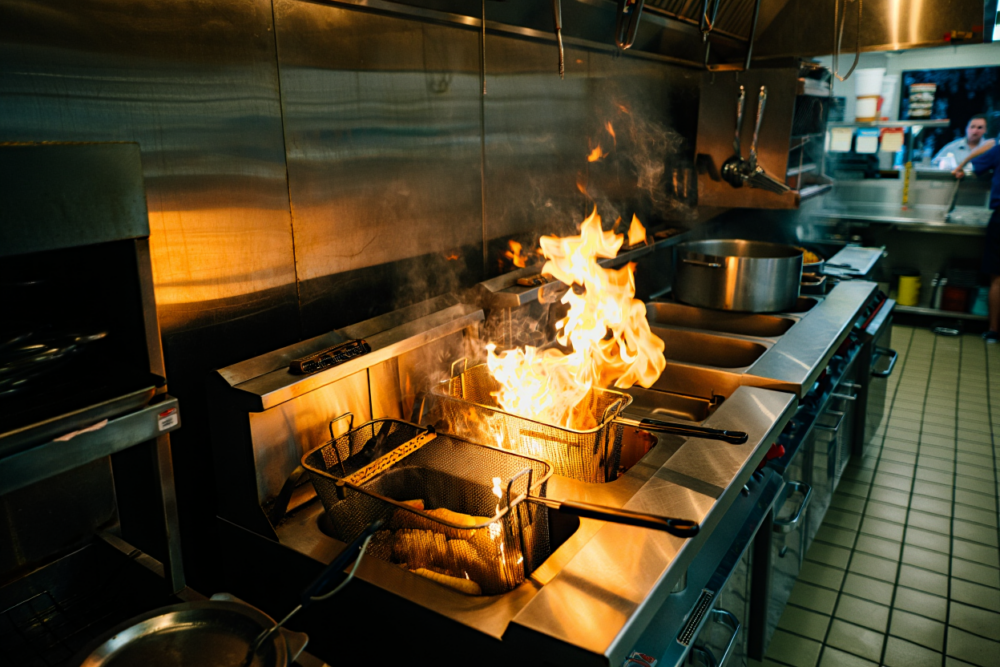
After years of working in the food service industry across Southeast Michigan, fires in restaurants, I found, are quite common. Putting out a grease fire has an entirely different process and procedure than other types of fires.
First and foremost – putting water on a grease fire is absolutely the last thing to do! Although it might seem like the right thing to do, it is not, because water will just disperse the grease and further spread the fire, ultimately making it even harder to control or extinguish.
Using a Class K extinguisher is the best line of defense with a grease fire. However, if you do not have one, Lincoln County’s official government site out of North Carolina suggests the following recourse for putting out a grease fire, “If the worst happens and your oil does catch on fire, do the following:
- Turn the Heat Off – Don’t try to move the pot. You might accidentally splash yourself or your kitchen with burning oil. And that would be bad.
- Cover the Pot with a Metal Lid – Fire cannot exist in the absence of oxygen. With the lid on (and the heat off), the fire should quickly consume all the oxygen and put itself out. Use a metal lid since glass will shatter.
- Pour on Baking Soda – Baking soda will extinguish grease fires, but only if they’re small. It takes a lot of baking soda to do the job.
- Spray the Pot with a Class B Dry Chemical Fire Extinguisher – This is your last resort, as fire extinguishers will contaminate your kitchen. Still, it’s better than the alternative if the fire is getting out of control.
- Get Out and Call 911 – If the fire does break out of control, don’t try to be a hero. Get out and find a phone to call 911,”.
Furthermore, many local fire codes now require commercial kitchens to have automatic fire suppression systems installed directly above cooking equipment. These systems activate when they detect excessive heat or flame, releasing a special extinguishing agent designed for grease fires.
Additionally, some restaurants also undergo unannounced fire safety inspections to ensure compliance and identify risks before they lead to incidents. In busy establishments, assigning a designated “safety lead” per shift can also help maintain awareness and readiness in high-pressure environments.
What class of fire is a cooking oil fire?
Since most of the fires I witnessed were in the kitchen/back of the house, some type of combustible cooking oil generally caused them, which took place in the deep fryers by an inexperienced cook, never a chef. When a chef was involved, it was usually because they were working so fast with too many pans going at once.
The National Fire Protection Agency reports that, “NFPA statistics show that for eating and drinking establishments, the majority of fires occur in the kitchen and specifically involve cooking equipment. Fire extinguishers that are rated for Class K fires (those involving animal fats or cooking oils) are the only type of extinguisher that can be used on fires involving animal fats or cooking oils. This is because many other types of extinguishers will either be ineffective or could even make this type of fire worse,”.
Class K fires are particularly challenging in the restaurant industry due to their unique characteristics. Unlike other fire types, Class K fires are fueled by highly flammable cooking oils, grease, and fats. When these substances reach high temperatures, they can ignite and burn rapidly, creating intense flames and thick smoke.
Because of their chemical makeup, these fires require specific extinguishing agents found in Class K fire extinguishers, which form a protective barrier and cool the affected area to prevent re-ignition.
Restaurants with high-volume cooking, such as those that utilize deep fryers, are especially at risk. Implementing stringent safety measures is essential. Key strategies include regular cleaning of kitchen equipment to prevent grease buildup, proper staff training on fire prevention and extinguisher use, and routine maintenance of fire suppression systems.
The goal is not just to extinguish fires but to proactively minimize the likelihood of their occurrence, protecting both staff and patrons.
Different types of restaurants
I have worked in many types of restaurants, from five-star chef-run places to small mom-and-pop burger and beer joints, as well as everything in between. I rarely preferred working at corporate-run or chain restaurants, as I made more money in tips at privately owned restaurants.
For example, as listed below, I have worked at these restaurants in various roles, including the following, such as but not limited to:
- Poole’s Tavern – head server and bartender
- The Moose Preserve – server
- Ernesto’s Italian Restaurant and Trattoria – server
- Steve and Rocky’s – bartender
- Duggan’s Irish Pub – server
- Steak and Ale – server
- House of Woo – server and bartender
- Big Boy’s Restaurant – cook
- Roman Forum – salad and dessert girl
- Tavern on the Main – bartender
- Outback Steakhouse – server
- Max and Erma’s – server
- Lake Point Yacht Club – server
- Ponderosa Steakhouse – server (first job as a semi-waitress)
- Little Ceasar’s Pizzeria – cook and customer service
- Finger’s Saloon – server
- Roosevelt’s Restaurant – server
- Riffle’s Restaurant -server
- Chicago Roadhouse – server
After working at all these establishments, I only witnessed a handful of fires, and they were in the kitchen or, as restaurant people call it, the “back of the house.”
According to data collected by the U.S. Fire Administration, “No matter the type, however, each restaurant poses unique fire risks as it engages in cooking activities and large numbers of customers potentially gather at one time.
Restaurant fires accounted for about 6% of all nonresidential building fires reported to fire departments each year. These fires resulted in an average of less than one fatality per 1,000 fires, 11 injuries per 1,000 fires, and $23,000 in loss per fire,”.
How to put out a grease fire on the stove
In conclusion, prevention and preparedness go hand in hand when it comes to keeping kitchens safe. Know your equipment, train your team, and act quickly; these simple habits can prevent a small flare-up from becoming a dangerous, costly emergency in seconds.