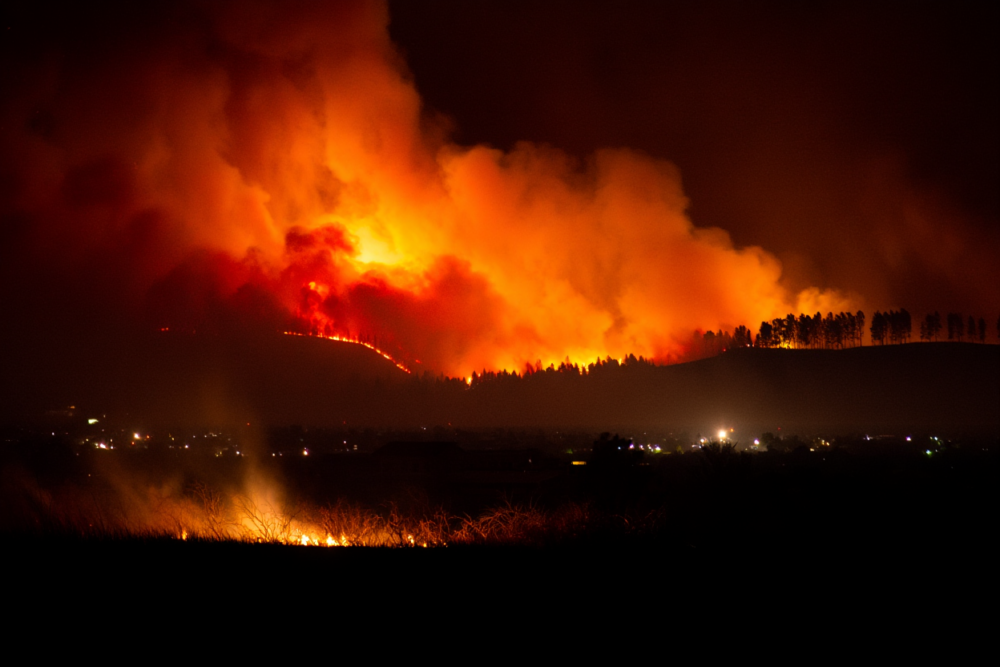
California has recently had the most properties at risk of wildfire damage by a significant margin. Although they are not the only state in danger. Unfortunately, my “home away from home” state of North Carolina also made the wildfire list at number three.
According to The World Population Review, “Wildfires vary in size depending upon factors including weather, location/accessibility, vegetation/combustibles present, and availability of fire crews.
Because of this variation, the number of wildfires in a state is an inexact indicator of the total acres burned in a state.
The most obvious example of the indirect connection between number of wildfires and total acres burned is arguably Alaska, where factors such as remoteness, terrain, and low firefighter availability often make wildfires more difficult to contain.
In 2023, Alaska experienced 346 wildfires, which burned 314,276 acres. The only state to lose more acreage (332,722) was California, which experienced 7,364 fires—more than 20 times as many as Alaska. The state closest to Alaska by number of wildfires was Nevada, which endured 375 wildfires and lost only 1300 acres,”.
However, California has been the state most threatened by wildfires, as 40% of all burned acres recently fell within its borders. The World Population Review cite the following States in order of wildfire severity along with the amount of wildfires from their 2023 data:
- “California 7,364
- Texas 7,102
- North Carolina 5,214
- Florida 2,730
- Georgia 2,386
- Mississippi 2,383
- Oregon 1,979
- Pennsylvania 1,910
- Alabama 1,856
- Arizona 1,837,”.
From the time I was a little child, I dreamed of moving Out West like the Hippies of my Mother’s generation did. Or, like the gold miners did during the California gold rush (1848–1855). It may not be gold these days, but it is possibly some golden dream that lies out West.
However, growing into an adult and seeing all of the natural disasters that occur in these above states, plus the cost of living, has deterred me and redirected my dreams.
Plus, I adore living in Pure Michigan, with its employment opportunities, high excellence in education, sports, food, the ever-changing enjoyable seasons, and most importantly, 20%* of the world’s freshwater, I now understand why my ancestors chose to migrate to Michigan from Ellis Island, NY and stay here.
*The combined lakes contain the largest supply of fresh water on earth; 20% or one-fifth of the earth’s total fresh water, with more than 3,000 miles of shoreline, the Great Lakes not only form Michigan’s geography, but also shape our economy, society, and environment. –Michigan Department of Environment, Great Lakes and Energy.
What is the most deadliest wildfire in US history?
While states like California and Texas seem to have terrible bouts of wildfires these days, they still do not hold a candle (no pun intended) to the most deadliest wildfire in the United States history: Peshtigo Fire, Wisconsin (1871).
From the National Weather Service (NWS), “Fire reached Peshtigo during the evening of Sunday, October 8, 1871. By the time the fire ended, it had consumed ~1.5 million acres, and an estimated 1,200-2,400 lives (exact number unknown), including approximately 800 in Peshtigo. Only one building in the town survived the fire,”.
NWS went on to add, “The fire in Peshtigo resulted from a number of factors, including prolonged drought, logging and clearing of land for agriculture, local industry, ignorance and indifference of the population, and ultimately a strong autumn storm system occurring in the presence of conditions supportive of a large, rapidly-spreading fire,”.
What are 90% of wildfires caused by?
According to the National Park Service, “Human-caused wildfires are significantly more common, with human involvement triggering 85% to 90% of wildfires. For any fire to occur, there are three elements needed—heat, fuel, and oxygen: Heat. Human-caused fires result from campfires left unattended, the burning of debris, equipment use, and malfunctions, negligently discarded cigarettes, and intentional acts of arson,”.
When I was merely two months old, my mom and her parents (my grandparents) took my same-aged boy cousin and me camping for the first time, which spawned a lifelong love of the outdoors.
We were taught at a very young age about fire handling and safety as well as the dangers. We were also little during the 1970s when the “Smokey Bear” television PSAs were popular. Old Smokey is still around, I hear, but that wise bear sure did help me think more conscientiously about our campfires.
The Forest Service authorized the creation of Smokey Bear on August 9, 1944, and the first poster was delivered on October 10 by artist Albert Staehle that same year.
In addition to the direct causes mentioned earlier, indirect human activities can also contribute to the spread of wildfires. For instance, power lines and electrical equipment can malfunction and generate sparks, igniting nearby vegetation. Similarly, fireworks and other pyrotechnics, if not handled properly, can quickly start fires, especially in dry and windy conditions.
However, despite these efforts, wildfire continues to pose a significant threat. Factors such as climate change, urbanization, and the increase in human activities in wildland areas can exacerbate the risk of wildfires. Warmer temperatures, prolonged droughts, and changes in vegetation patterns create ideal conditions for the rapid spread of fires.
Additionally, the encroachment of residential areas into wildland areas increases the potential for human-caused ignition sources, as well as the difficulty in controlling and extinguishing fires.
People must be mindful of their actions and take precautions to prevent these accidents from happening. Efforts to educate the public about fire safety and prevention, like the Smokey Bear campaign, play an essential role in reducing the number of human-caused wildfires.
Smokey Bear, with its simple yet powerful message, reminds people of their responsibility to protect our natural surroundings. This iconic character has become deeply ingrained in the public consciousness, serving as a symbol of environmental stewardship.
USA wildfire statistics by state
In conclusion, wildfires are a growing national concern, and the data makes that undeniably clear. Whether sparked by human carelessness or climate conditions, prevention starts with awareness. So the next time you’re near an open flame outdoors, channel your inner Smokey Bear — because only you can prevent wildfires.